

A Western wedding usually asks transport to do one thing well: get people to a ceremony and a reception on one evening. An Indian wedding asks for much more. There may be a mehndi and sangeet on Friday, the wedding on Saturday morning with the groom's baraat arriving in procession, and a reception that evening, each with its own guest list, its own dress code and, for many families, a ceremony time set by the priest that the whole day is built around. Many of the guests drive in from Brampton, Mississauga and the rest of the Greater Toronto Area, and many of the most important guests are grandparents.
Indian wedding transportation in Niagara works when it is planned event by event, with the elders and the muhurat at the centre. NiagaraFallsLimo.net books the vehicles; this guide explains how to put the plan together.
How should you plan transport for an Indian wedding in Niagara?
Plan each event separately: guest arrivals from the Greater Toronto Area, the baraat arrival, the ceremony, the reception and late returns. Brampton to the Fallsview hotels is about 124 km (77 mi), usually 1 h 35 – 1 h 50 off-peak. NiagaraFallsLimo.net books Sprinters, SUVs, stretch limousines and coaches on request in its online booker, fixed fares shown first.
The key word is separately. A single "shuttle all weekend" booking sounds simple but tends to fail, because the mehndi crowd, the wedding-morning crowd and the reception crowd are not the same people and do not want to travel at the same times.
Map the weekend before you book a single vehicle
Lay the events out in a grid, with who attends, where they sleep and when each event starts and ends. A common shape:
| Event | Typical guests | Transport need |
|---|---|---|
| Mehndi and sangeet, Friday evening | Close family and friends | Hotel to venue and back, late return |
| Baraat and wedding, Saturday morning | Everyone | Groom's arrival vehicle, guest shuttles, elders first |
| Reception, Saturday evening | Everyone, often more guests | Shuttles from several hotels, two or three return runs |
| Farewell brunch or departures, Sunday | Out-of-town guests | Airport and GTA returns |
Each line becomes its own set of bookings. Doing this on paper first usually shows that two events can share vehicles and one cannot, which saves both money and arguments on the day.
Where the guests are coming from
Most guests at a Niagara Indian wedding travel from the Greater Toronto Area, and the drive is long enough that it matters.
- Brampton to the Fallsview hotels: about 124 km (77 mi), usually 1 h 35 – 1 h 50 off-peak, and 2 h or more on a summer Friday afternoon.
- Mississauga to the Falls: about 110 km (68 mi), usually 1 h 20 – 1 h 40 off-peak. Our Mississauga to Niagara Falls route covers the roads.
- Toronto Pearson for guests flying in from India, the UK or the US: about 121 km (75 mi). See our Pearson to Niagara Falls transfers for flight-tracked pickups and meet-and-greet in arrivals.
- Buffalo Niagara International for guests from US cities: about 43 km (27 mi) to the Fallsview hotels, plus the border.
All the GTA routes run along the Queen Elizabeth Way (QEW), the main highway around the western end of Lake Ontario. Some drivers use the 407 ETR, a private toll highway billed electronically by licence plate, for part of the trip. For guests who arrive the day of the wedding, build in the summer Friday and Saturday-morning traffic; for most families, the better plan is to bring everyone down the day before.
The baraat: what transport actually has to do
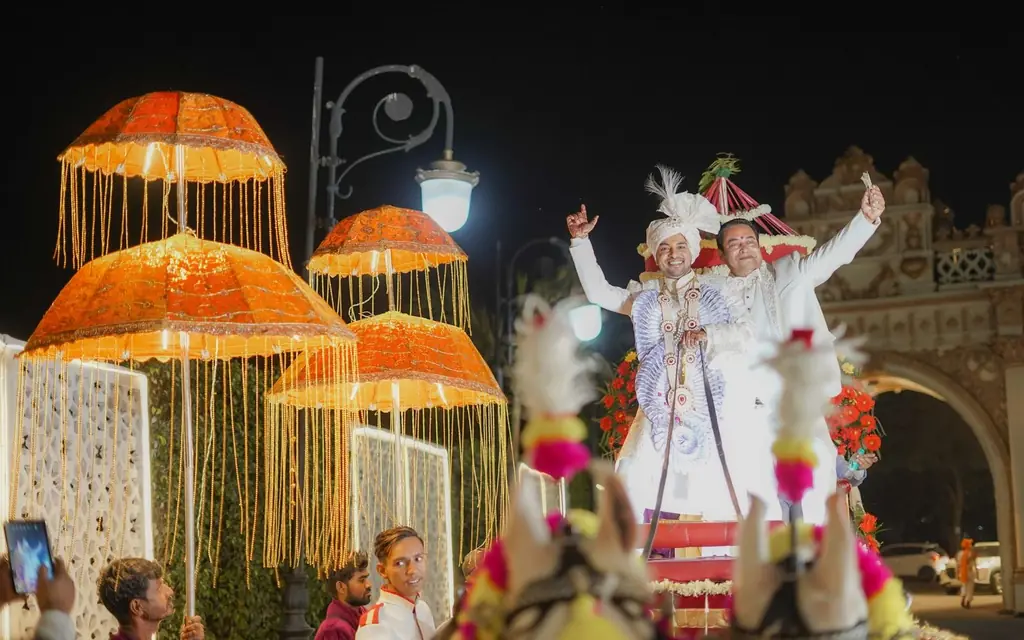
The baraat, the groom's procession to the venue with family, music and dancing, is the most photographed moment of the morning and the one with the most moving parts. Transport has three jobs in it.
Get the groom's party to the starting point, early. The procession usually begins a short distance from the venue entrance, at a spot agreed with the venue. The groom's vehicle, often a Rolls-Royce, Mercedes-Maybach or a Stretch Limousine, drops the groom and his closest family there, with time for turbans, garlands and photos before the music starts.
Get the car out of the way. Once the procession starts, the vehicle needs to leave the area so it does not block the route or the photographs. Agree with the venue where the chauffeur waits.
Bring the elders ahead. Grandparents and anyone who cannot walk the procession route should be taken straight to the venue door before the baraat begins, so they are seated to watch it arrive.
What transport does not arrange is the procession itself. Where the baraat may go, whether a horse is allowed, whether drums can play and at what volume are questions for the venue first, and if the procession would use a public road, ask the venue and the municipality what permission is needed. Our stretch limo and Sprinter page shows which vehicles suit the groom's party.
Working backwards from the muhurat
For many families the ceremony time is fixed by the priest and is not negotiable. Treat it like a flight departure and work backwards:
- Ceremony start, for example 10:30 a.m.
- Baraat arrives at the venue entrance and the milni takes place: allow 30–45 minutes before the ceremony, depending on the family.
- Baraat procession starts: 20–30 minutes before that.
- Groom's car leaves the hotel: early enough to reach the starting point with 20 minutes to spare.
- Guest shuttles: leave first, so guests line the route before the procession sets off.
- Elders' vehicle: leaves before everyone, straight to the venue door.
Put each time on one sheet, give it to every chauffeur, the planner and one family contact on each side. If the morning slips, the planner calls the reservations desk once, not five different drivers.
Elders, accessibility and outfits
Three practical issues come up at almost every Indian wedding we drive.
- Mobility. Book a wheelchair option in the booker for anyone who needs it, and give elders their own vehicle so they are never waiting on a full shuttle. Our accessible transportation page explains what is available.
- Outfits. Lehengas, sherwanis and changes for the reception take space. An Executive Sprinter carries up to 12 passengers but only carry-on luggage, so garment bags for the bridal party should go in a Standard or Executive Black SUV, which takes up to 6 passengers and 6 bags.
- Children. Cousins and nieces at a family wedding often number in the dozens. Child, toddler and booster seats are booker options; list them per vehicle.
Sizing the fleet for a large guest list
At 200 or more guests, shuttles become a logistics exercise. Some guidance:
- Coaches on request move the largest groups efficiently between a main hotel and the venue.
- Executive Sprinters (up to 12) handle smaller hotels and late returns.
- Standard SUVs (up to 6) give families with young children or elders their own ride.
- Two or three return runs after the reception, the first around 10:30 p.m. for older guests.
Our group transportation service covers multi-vehicle coordination, and planners running several weddings a season can set up event and wedding planner bookings.
The officiant, the licence and the rules on board
Ontario requires an Ontario marriage licence (or banns in limited circumstances) and an authorized officiant. Under the province's getting married rules, that can be a registered officiant recognized by a religious body, or a civil officiant such as a municipal clerk. If your priest is coming from another province or country, check well in advance whether they are registered to marry in Ontario; some families add a short civil ceremony to cover the legal side. The Niagara Falls marriage licence is issued at City Hall, 4310 Queen Street.
On board, the rule is simple: no drinking in our vehicles. Niagara Region's vehicle-for-hire by-law says a licensed driver must not permit the consumption of any alcohol in the vehicle. Celebrate at the venue; the shuttles get everyone back.
Chauffeur vs rideshare vs taxi for this trip
| Way to go | Door-to-door time | Cost note | Luggage | Best for |
|---|---|---|---|---|
| Pre-booked chauffeur and shuttles (NiagaraFallsLimo.net) | Vehicles at set times for each event | Fixed fare via booker, shown before you pay | SUV 6 bags; Sprinter carry-on only | Baraat, elders, guest groups, late returns |
| Rideshare | Matching delays when many guests leave at once | App estimate; surge pricing likely at peak | Varies | Individual guests on a free afternoon |
| Taxi | Dispatch wait; limited large vehicles | Metered | Sedan or minivan | A guest leaving early |
| GO train to Niagara Falls | Scheduled; then a local ride to the venue | GO fare | Standard bags | GTA guests travelling light the day before |
| Guests driving themselves | Long drive plus parking | Fuel, 407 ETR tolls if used, parking | Own trunk | Families who want their own car all weekend |
Verdict. For a cousin exploring Clifton Hill on Friday afternoon, a rideshare or taxi is perfectly fine. For the wedding morning, when two hundred guests have to be in place before a fixed ceremony time and elders need to be seated before the baraat, depending on app availability is a real risk. Pre-booked vehicles, assigned to each event, are what keep the muhurat. Our chauffeur vs taxi vs rideshare guide goes deeper into the comparison.
Who it suits
Couples use one premium car for the groom's arrival and the couple's exit. Individuals flying in alone from overseas can be met at Pearson with a name board. Families travelling with grandparents and children are the core of this plan: their own vehicle, seats arranged, no waiting. Groups of guests from the same hotel share Sprinters or a coach for each event.
Booking it with NiagaraFallsLimo.net in 3 steps
- Enter each event as its own trips. In the online booker, add every leg with addresses, dates and times: hotel to sangeet, baraat start point, venue, reception, returns.
- Choose vehicles for each leg. Each class shows its fixed fare before you pay, so you can compare a coach against several Sprinters.
- Add passenger notes and pay. Elders and wheelchair needs, child seats, garment bags, family contacts. Pay securely; confirmations arrive by email.
For the general pattern of hotel, ceremony and reception, see moving guests between hotel, ceremony and reception, and for city-based guests, wedding guest shuttles from Toronto hotels.
Frequently asked questions
How far is Brampton from Niagara Falls for wedding guests?
About 124 km (77 mi) from central Brampton to the Fallsview hotels, usually 1 h 35 – 1 h 50 off-peak on the QEW, and 2 h or more on a summer Friday afternoon. For a morning ceremony, guests are better off arriving the evening before.
Which car is best for the groom's baraat arrival?
Families usually choose a Rolls-Royce or Mercedes-Maybach for the groom and one or two family members, or a Stretch Limousine for up to 8 when the groom's party rides together. The Rolls-Royce, Maybach and stretch are confirmed at booking.
Can the limo drive in the baraat procession?
The procession route, music, horse and timing are set by the venue and, on public roads, may need municipal permission. Usually the car drops the groom at the agreed starting point and then leaves the area. Agree the plan with the venue first and add it to the booking notes.
How many vehicles do we need for 200 guests?
It depends on how many guests drive themselves and how many hotels are involved. As a guide, coaches on request move the main hotel group, Sprinters for up to 12 cover smaller hotels, and SUVs serve elders and families. The booker shows the fixed fare for each combination.
Can elders travel separately from the main shuttle?
Yes, and we recommend it. Book a Standard SUV or a sedan for elders, leaving before the guest shuttles, so they are seated at the venue before the baraat arrives. A wheelchair option and child seats are available in the booker.
Do we need an Ontario-registered priest?
Ontario requires the marriage to be performed by an authorized officiant, either a registered officiant recognized by a religious body or a civil officiant such as a municipal clerk. If your priest is not registered in Ontario, check the options early or add a civil ceremony.
What happens if the ceremony time moves on the day?
The planner or family contact calls the reservations desk once, and the vehicles are adjusted where they are not committed to other bookings. That is why a single timetable shared with every chauffeur matters: one call changes the whole plan.